Sunday, June 22, 2014

Hamlet Town

Aside from the woman at the counter, this was what greeted me when I first arrived at my hotel in Helsingor. It's a picture of British actor Derek Jacobi playing Hamlet, and this scene is a famous one where he finds the skull of Yorrick, the king's jester in the old days, and meditates rather gloomily on how no matter how great you might have been in life, you will still end up in a grave one day.
 
 
My digs here at the Hotel Madam Sprunck are quite cozy.  The room is smaller than in Copenhagen, but the bathroom is a little larger, with the shower section clearly set apart from the toilet, which is nice.  This building is quite old, and there are wooden beams running across the ceiling of both the bedroom and bathroom, though someone has painted them white (a shame).

 
After dropping off my bags, I headed to this restaurant, which dates back to the 1600s and has two British Royal Navy cannonballs lodged in the cellar back from when Lord Nelson was going around making sure there was no fleet left in Denmark to help Napoleon.  The sandwich I had there was a little disappointing after the fare I've eaten in Copenhagen, but the atmosphere and lower price of the food made up for it.


This town has retained a great deal of its historical character, some of it dating all the way back to the medieval period, so even though it was raining on and off all afternoon (mostly on), I thoroughly enjoyed walking up and down its charming roads. 


Apparently things close up early on Saturdays, though, because all the shops were done for business by the time I finished lunch, which was about 3:00 in the afternoon.  The liquor store across from my hotel remains open, as do many cafes and bars, in order to accommodate all the Swedes who ride the 20-minute ferry over from Helsingborg to drink.  Apparently there's quite a stiff tax on alcohol in Sweden, so they pop over here to indulge.
 
My favorite part of the afternoon was discovering this beautiful location, which was established as a convent in the 1400s, then became a hospital for the old and infirm after the Reformation.  I was lucky enough to have the place to myself as I explored, and after all the busyness and stimulus of the past week, it was a very welcome respite of peace and quiet. 


There's always something profound about running your hands over bricks and mortar that were touched by hands over 500 years ago.  Sitting in one of the arches and listening to the breeze blowing through the massive tree in the center made me see some of the appeal of life in a convent.  Especially one as lovely as this one.  The video below is sideways, unfortunately (the only way to capture the whole tree was to turn my camera), but enjoy a few peaceful moments yourself:
 
 
 This is what it looked like upstairs:


And this charming little building was out back.
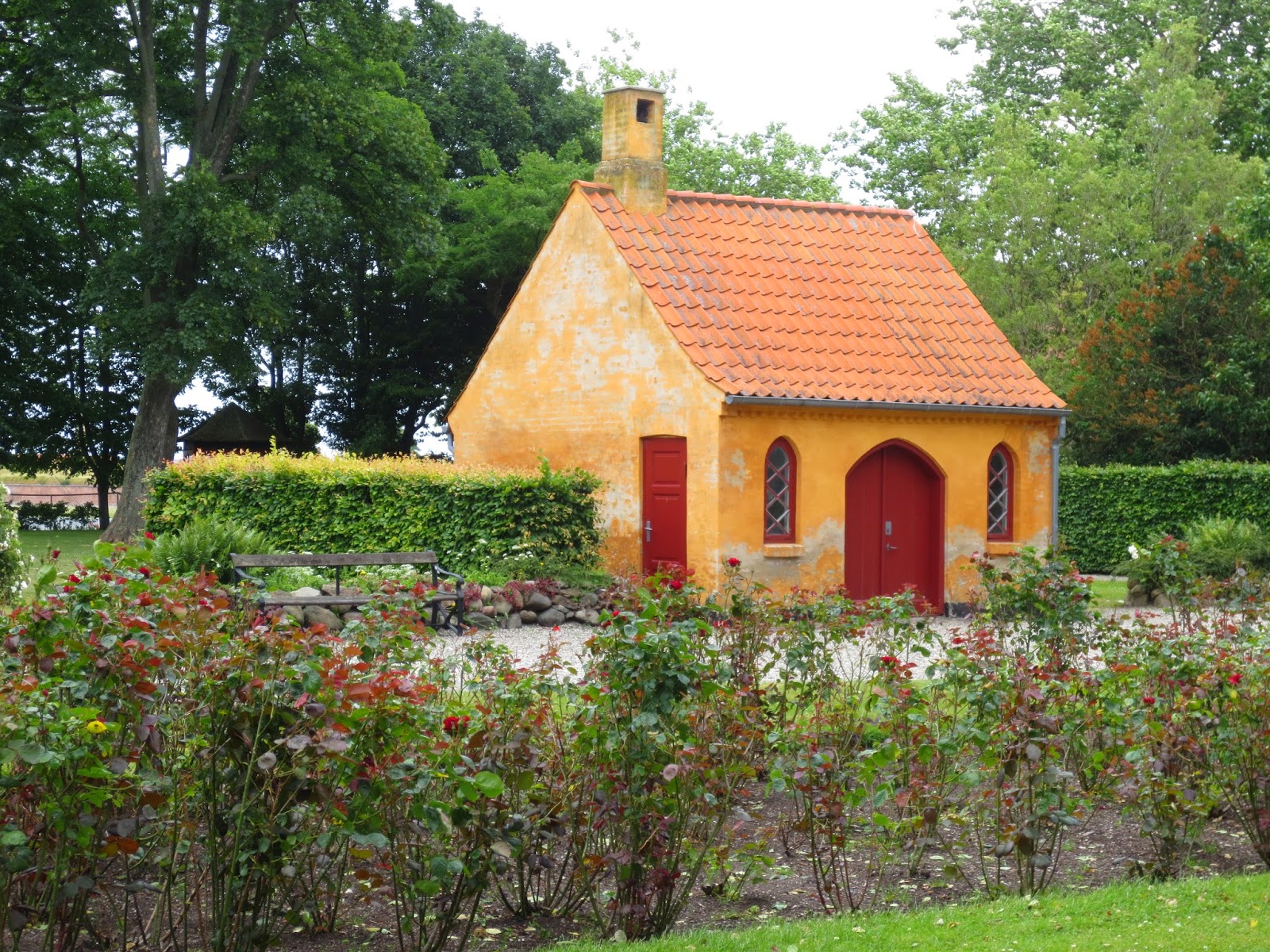
 
Beyond the cottage is another stretch of grass, and then there's the sea.  You can hear the call of seagulls from all over town and smell the salty tang of the water.
 
This morning, I attended church at St. Olaf, which is absolutely gorgeous inside, but which I cannot share because photos are not allowed even when there isn't a service going on. Even though I don't speak Danish, I still enjoyed all the hymns (though the congregation seems to be made up of about 25 senior citizens, there is still an organ and full choir singing) and recognized from a few key words when they were reciting the Apostle's Creed.  I also got to see the baptism of two babies.  Church is church wherever you go, which I find both beautiful and reassuring.  
 
After that, I spent a good four hours exploring the famous Kronborg Castle, including a relaxed lunch at the cafĂ© with another London couple and an American woman from New York.  I saw them recognize each other from the train, and when the American asked if she could join them, I sort of jumped in as a kind of double-crasher to the party, and it turned out to be great fun. 
 
Anyway, back to the castle/fortress, which in the medieval period was a simple square structure (called "Krogen") that was mostly just walls and a couple smallish dwelling places.  Then Frederik II came along and built most of what is now Kronborg, with additions and embellishments added in later years by (you guessed it) Christian IV (Frederik's son).  The weather varied today between brilliant sunshine and rain, appropriately changeable and moody, I suppose.  There's not just one but two moats, and crossing over the second one, I happened upon a little family of swans.
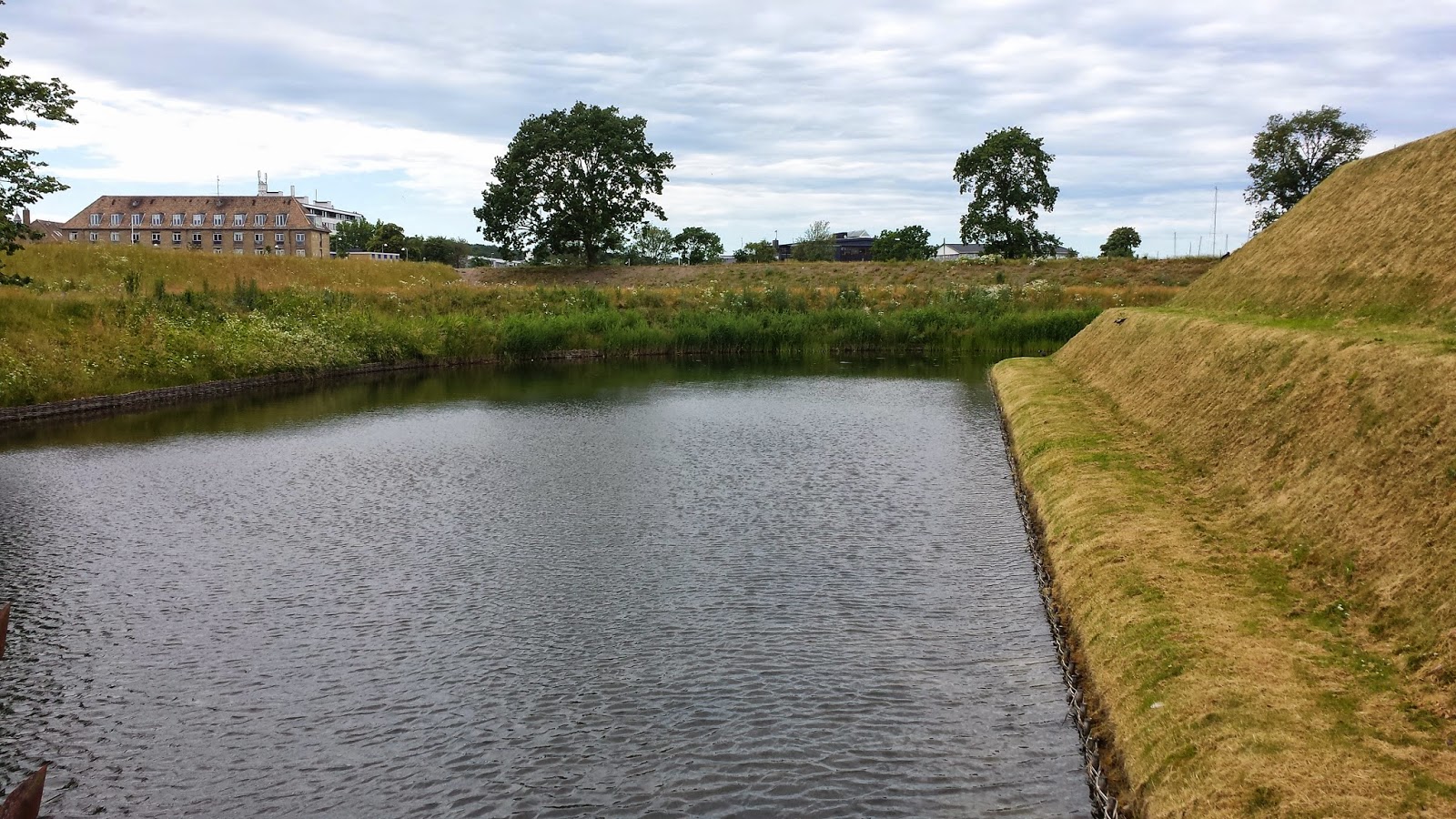


It's hard to get a sense of just how massive this structure is without being there in person, but this should give you an idea.  Take note of how many windows there are, which (because of how expensive glass was in those days) was another way for Frederik to flaunt his wealth.


The large majority of construction was funded by something called the "Sound Dues," which was a toll system established by Erik of Pomerania in the 1400s.  What Kronborg (and earlier Krogen) overlooked is this:
 
This strip of water, known as "The Hook," separates Denmark on this side, and Sweden on the other ("I can see Sweden!").  Only for centuries, Sweden was actually part of Denmark, and because he had sovereignty over the land on both sides of this stretch of water--which was the only passage from the Baltic Sea (basically anything coming to or from the Middle East) to the rest of the world--Erik realized he could make a fortune by charging all the ships a fee to go through.  When a ship came by, it was supposed to lower its flag halfway to show it was coming into port to pay the toll.  If it didn't, then a warning cannon was fired off, and the non-compliant ship would then have to pay both the toll and the cost of the cannon ball.
 
 
When a fire destroyed the entire interior of the castle, Christian IV simply doubled the toll to fund the rebuilding.  This system not only made Denmark a lot of money, but the kings and queens who lived here also benefitted from having first dibs on buying whatever luxurious and exotic goods were passing through on the ships.
 
Because of the fire and because of the castle's function as a military barracks for decades in the late 19th and early 20th century, the interior doesn't look very much like it did originally (or even as it did after the fire) and the plain white walls and ceilings (and floors) would have been much more heavily decorated.  The black and white marble floors and the tapestries are some of the few remaining authentic details that are actually from Kronborg.  Many of the other items were brought in from other locations, though they replicate or match the types of art/furnishings of Christian IV's period, so I'm not really going to bother putting up photos of those rooms (trust me, you're not missing anything).  What I will put up are photos of one of the surviving tapestries and photos from the chapel, which was the only part of the castle untouched by the fire.  The elaborate panels, colors, and detailing is what we were told the rest of the castle would have had as well.  Interestingly enough, this chapel was the first constructed specifically as a Reformed chapel and not a Catholic one.


(this shot came out a bit blurry because of the low light--this is the ceiling paneling)


Again, very dark and heavy (like Rosenborg Castle's interior) but beautiful.  The real "wow factor" (Frederik might not have had the term, but he understood the concept) is this ballroom, which was the largest one in Europe at the time.  Frederik wanted to impress everyone visiting with Denmark's wealth and power, and this must have done the trick because it was famous all over Europe.  No one knows for sure if Shakespeare actually ever visited this castle himself, but it is possible since English and Scottish actors ("players") were brought in to perform for royalty, and King James of England (the same one who sponsored Shakespeare's acting troupe) once stayed at Kronborg with his Danish wife for four months.  Either way, Shakespeare would have been familiar with the grandeur of this castle, and since this was a hub of commerce at the time, it seemed a natural fit to be the setting for Hamlet.
 
 
 Above is a shot when it was empty in the afternoon and below is a shot of it filled with some sort of military event that was going on in the morning when I first arrived, which also gives a sense of its massive scale.
 
 
And this is the Queen's Gallery/passage, which Frederik had built for his wife Sophie so she could get to both the chapel and the ballroom without having to cross the cold, wet courtyard (her chambers were separate from Frederik's, as was the custom of the day).
 
 
Our modern sensibilities might be somewhat creeped out by the fact that he was 38 and she was only 14 (and they were cousins) when they first met, but a number of sources seem to indicate that they were genuinely in love and had a great affection for each other, which was something of a rarity in royal marriages of that time.
 
Some random pictures of doors, because I am slightly obsessed with old doors:


Guess who had the door above ordered?  That's right--as always, he left is trademark "C" with the "4" embedded right under the knocker.
 
 
A super cool passageway
 
 
and a parting shot of the castle when the sun was blazing (the streak of light being some freakish--but neat--accident of my camera)
 
 
Now I am off for some dinner and am hoping I can find someplace to eat other than my hotel, which is ridiculously overpriced.  There are hardly any people here in town now--it's really more of a ghost town--as most of the tourists get back onto buses or the train to go elsewhere after a few hours here, and no one's coming over from Sweden to drink and party on a Sunday evening.  It's borderline eerie how quiet it is here, but it's also kind of a nice change.  Tomorrow I'm back on the train and headed south to Odense.


Friday, June 20, 2014

Towers, Castles, and Happy Happenstance

Since today was my last full day here, I ended up cramming in quite a lot.  After breakfast, I kicked the day off by walking down cool streets like this:

 
to get to this:

 
The Round Tower, as it is aptly named, was built by Christian IV in the 1600s as an observatory/astronomy tower, and for a few centuries it also housed the library of the University of Copenhagen.  It is attached to Trinity Church, where I stopped first to take a look and also to say prayers for some friends who are going through really difficult things right now.  


I then began my ascent up the tower.  Instead of having stairs, it simply has a steep ramp that circles you 7 1/2 times before you reach the top.  It was built this way so heavy equipment could be brought up by cart.  I think the man in this photo was feeling a bit like one of the horses of yesteryear pushing his son up in the stroller.

 
Near what used to be the library (and is now an exhibition room undergoing renovation) was a conveniently placed loo.  A little explanatory brochure pointed out that since Hans Christian Andersen most certainly studied in the library, he probably made use of these facilities (just think of that the next time you read one of his fairy tales).  Bringing in a pipe to smoke while they took care of business was such a popular practice among students that there ended up being a thick layer of nicotine they had to scrape off the ceiling during renovations.

 
The center of the tower is hollow, and at one point towards the top, they give you the option of crawling in through a small entrance and standing on a glass plate so you can see the drop down.  I must admit that I needed to take a breath to do this, but it was pretty cool.  I think it helped to read that in 1880 a choir boy fell all the way down and lay trapped behind the thick walls of the core for almost a full day, only to emerge (miraculously) with only a scraped arm and a few loose teeth.  So, no biggie.


The reward at the end of the climb, which really wasn't that bad given the gradual nature of it, was this:


After making my way back down, I headed across the street for a strawberry, banana, and apple juice blend that I later calculated cost me about $8.  Food here in Copenhagen isn't cheap (understatement of the century)--I have yet to eat a meal that doesn't cost at least $20-25--and that's for a sandwich, although they are pretty great sandwiches.  Anyway, refreshed by my juice and consciously willing myself not to cry at the price, I headed over to Rosenborg Castle, which was only a few blocks away.  The grounds there are beautiful, and quite a few people were enjoying sitting on benches, playing with their children, having picnics, etc.


The castle itself was built by Christian IV (shocker, I know) as a summer palace, but over the years it's turned into a kind of super fancy storage facility for the Royals to stash all their accumulated stuff.   There are rooms chock full of intricate clocks, crystal, everything and anything you can imagine made of gold, ivory carvings, etc.  Probably all the gifts they've received over the years, which adds up to quite a lot.  I guess if you've seen one gold clock with tiny figurines, you've seen them all.  I can imagine the kings and queens graciously thanking the giver, then as soon as the door closes beckoning a servant and saying, "Put it in Rosenborg" with an airy wave.  There were lots and lots of paintings and tapestries as well. 


The castle was beautiful and impressive for sure, but a reminder that I could never handle being a royal (not that this is ever a real possibility for me, but still).  It's all just a bit too heavy, ornate, and overwhelming for my taste.  This little cottage in the back is more my speed:

 
All that ostentatious wealth gave me an appetite, so I walked down to Nyhavn to see if I could get the sandwich from yesterday again (it was well worth a second go).  However, the place was packed, and the woman I spoke with informed me it would be an hour's wait.  That sandwich was good, but not worth waiting another hour, so I walked out and was just about to start wondering what to do next when I ran into one of the couples (Keith and Francis) from the UK party I'd sat next to yesterday.  They'd had the same idea, and when I told them about the wait, Keith said, "Well, let's go to the one across the street!"  The funny thing is that that was the restaurant their group had tried yesterday and it was too full, but today it was the other way around, and we ended up seated at a table with a pretty courtyard view right away.  While I am doing okay eating meals by myself and either people watching or reading on my Kindle, sharing a meal with Keith and Francis was much more enjoyable, and it is still making me smile that we ran into each other like that.


After a delightful meal together, they headed back to their hotel to pack for their flight back to London this afternoon and I walked over to the Ny Carlsberg Glyptotek.  Just about everywhere you go here, you see signs for Carlsberg beer, and the man who owned that company (Carl Jacobsen) used his considerable fortune to build this museum to house his art collection.  There is a gorgeous atrium in the center that fills the place with light.

 
Most of the art collection is actually sculptures (hence the "Glyptotek"), which range from Ancient Egyptian, Greek, and Roman pieces to more contemporary French and Danish sculptures ("contemporary" meaning 19th-century).  There's this impressive hall, lined with a bunch of ancient Roman statues, where they have concerts and lectures:


And here are some of the more contemporary works by various French and Danish sculptors.  The photos don't really capture how beautiful and dynamic (and large) they are in person.  It was all I could do to keep my hands to myself.

(Adam and Eve after the Fall)

(The First Funeral)
 
(The Return of the Prodigal Son)
 
I've just come back from a wonderful traditional Danish dinner from a restaurant two doors down from my hotel that I've been eyeing for a couple days now.  A wee bit pricey, but worth the splurge for my final night in Copenhagen, especially the strawberries and cream at the end for dessert.  I don't know why European yogurt and cream is so much more delicious than American yogurt and cream, but the difference is dramatic enough that it was one of the things I was looking forward to when I was preparing for this trip.  And I made more new friends at dinner.  A man and woman were seated at the table right next to mine (which was about four inches away) and I was careful initially to stay focused on my book since I thought they were on a date.  But the man (Henry) initiated conversation about 10 minutes into our respective meals, and things just took off from there (turns out they're colleagues).  Quite the character, Henry is, and all I had to do was listen and nod and laugh for most of the rest of dinner.  He owns a company that produces organic salami--"The best salami in the world!"--and made it very clear what he thinks about the US FDA's stupid labeling rules about how some of the ingredients (I assume he's talking about the nitrates) could cause cancer.  As he pointed out and I will now think about every time I go to the grocery store, the water they mist the lettuce, etc. with is "full of bacteria" and "far more dangerous" than whatever's in his salami.  Of course, he could be slightly biased. 
 
In a totally unexpected and poignant moment (I had asked if he had any children) he said he had two sons, but his jovial confidence faltered for a moment and he stumbled over the word "two," then revealed that one of his sons died of cancer at age 26.  "So you have two sons," I said, and his colleague nodded and echoed, "two sons" and he nodded and repeated, "Yes, I have two sons."  I asked about them both, and the one who died was named Daniel after one of the "best people" Henry had ever met while doing business in Australia years ago.  And his own Henry, he said, had been a "beautiful person" and "as good a man" as the original.
 
Which reminds me of how at lunch, after I shared where I was visiting in Scotland, Keith shared a memory of when he was a boy living in northern Scotland because his father was in the Royal Air Force stationed there, and how he had his own little boat and he'd go out in the water every day with his dog in the boat with him and fish for hours, and those were some of the happiest days of his life.  "I'd almost forgotten about that," he said, and even his wife looked a little surprised, as though she hadn't heard about this before. 
 
I find it both strange (in an incredible sort of way) and deeply moving how you can get these intimate little glimpses into someone's heart and soul in such a short time of knowing them.  In a strange and counter-intuitive way way, I think there's actually something about being complete strangers and knowing that we'll probably never see each other again that allows us to sometimes reveal more of ourselves and be less guarded than we'd otherwise be.  Whatever it is, I feel I've been given something precious.
 
Tomorrow I pack my bags and head up to Helsingor.  I'll most likely take a little break from this blog and return to it on Sunday.  Until then, thanks for all the lovely comments and wishes, which have all been good company as I go about my days!