Tuesday, June 24, 2014

Fairy Tale City

No matter where you are in Denmark, you're not far from the sea.  I was reminded of this on the train ride from Helsingor to Odense (by way of Klampenborg and Kobenhavn--"havn" meaning "harbor") where I got glimpses like this:


This was just one of a row of turbines, but I was too slow on the draw to get them all before the train whizzed away.  There was also field after field of lovely green and golden waves of crops, punctuated by the occasional row of bright red flowers (couldn't tell if they were poppies or tulips).  While Helsingor was charming in many ways, the people there weren't very friendly--they seemed a bit jaded, which, given the amount of tourists flooding in every day, is somewhat understandable.  All the same, it was refreshing (and mood-lifting) to arrive in Odense and find the same level of cheerful openness that I encountered in Copenhagen.  The cab driver who picked me up at the train station seemed rather grim at first, but after I asked a question or two, he livened up, and by the end of our seven minute drive together, he showed me several photos of his grandson on his phone before we got out of the car. 

My room here at the Ansgarhus Motel is very small and simple, but I find it cozy, charming, and the perfect size for being on my own.  It reminds me a bit of my dorm days, which were happy times for me.  I just have to watch my head a little with the sloping walls.


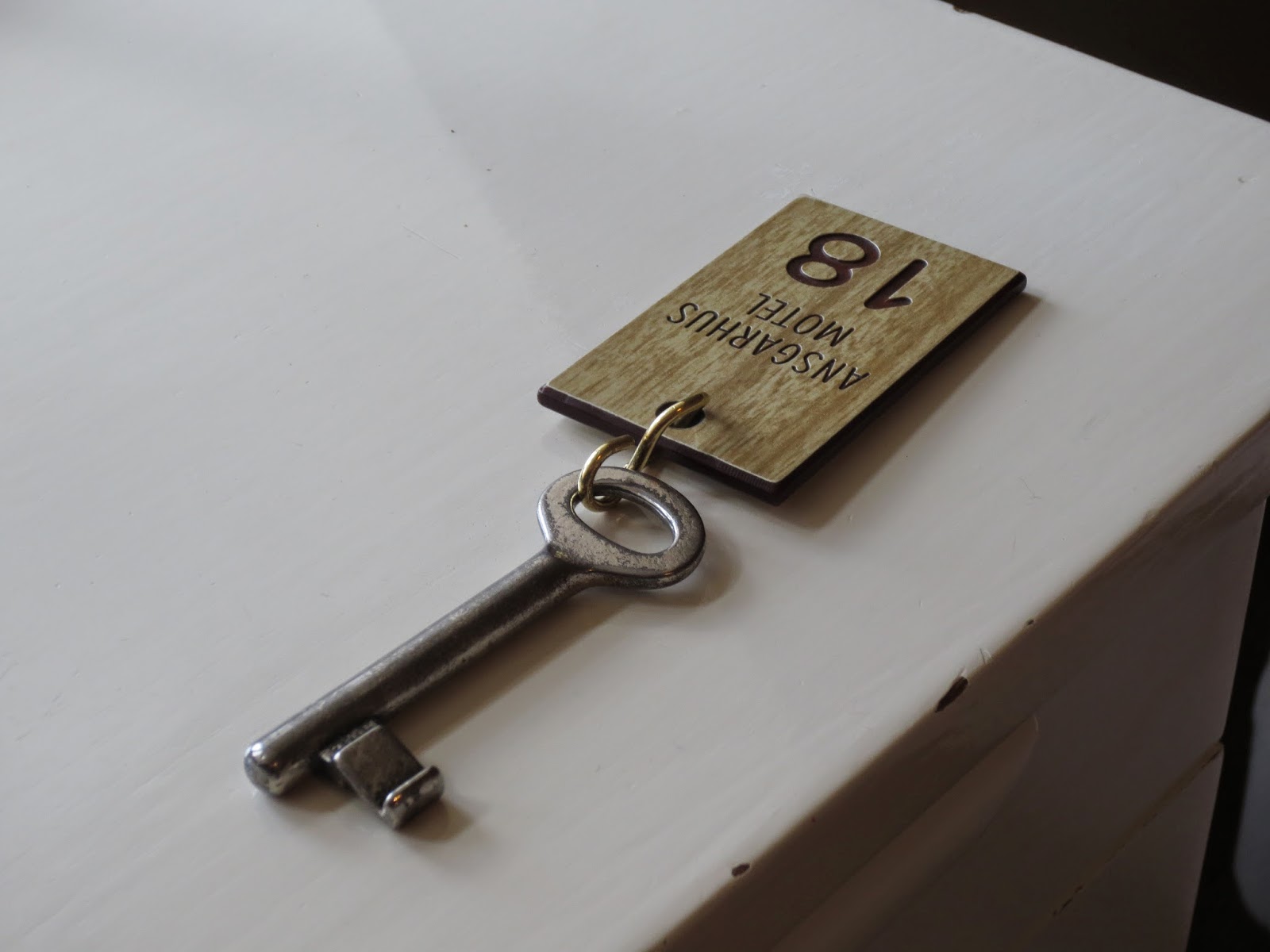
How can you not be charmed by a room with a key like this:

Or a window like this:


Not to mention the artwork (someone really should have told this lady that her breasts were hanging out of her dress):


Though everything was closed by the time I arrived by train, checked in, and ate some lunch (all the museums, etc. shut down here around 4:00), I still enjoyed walking around.  Odense is the birthplace of Hans Christian Andersen, whose collected works I've been reading over the last few days, and it's easy to see where he got the inspiration for his fairy tales.


These houses (near the H.C.A. museum and house) are all very typical of the houses from his childhood.  Sadly, my taxi driver said a huge number of them were destroyed when they built the main road through the city fifty years ago, but at least these remain.


On my walk back to my hotel, I discovered this lovely park with a statue of Hans Christian himself at its center:


I sat down on a bench facing this (above), and seconds later, a bird flew over to the fountain to take a drink.


And here's one of me enjoying the moment.  


I suppose I'll have to get better at having other people take pictures of me in various historic sites, but I generally hate posing for photos by myself and always come out looking as stiff/awkward as I feel.

Today I headed back to the Hans Christian Andersen museum, which is built around the rooms where he was most likely born (his parents didn't have a place of their own, so it's assumed they stayed with relatives who lived here for his birth).  Having read several of his stories in the last several days, I can understand where some of the darker elements come from given a more complete picture of his life.  The mortality rate of infants and children was about 40% at the time he was born, he lived in extreme poverty for his entire childhood and a good portion of his young adult life, and even though he fell in love several times, none of the women returned his feelings and he remained unmarried and childless his entire life, though he longed for a family of his own.  He also lost his father, whom he loved very much, at a young age, and his mother ended up being an alcoholic.  He left home to try and break into the theater scene in Copenhagen when he was just 14 years old.

Below is the home where he lived with his father (and then mother after his father died) from age 2 to 14.  This was not theirs alone, however--two other families also lived in the same dwelling, and each family had only one room to themselves.


This was the Andersen room


And this was the kitchen (no running water--they had to fetch that from the river) shared by all three families.  It's hard to tell from the photo, but there's about enough room for two (maybe 3 if you don't need to mover your arms) in there.


When the woman at the front desk told me that one of the families in the other rooms had five children, I asked how they all possibly fit in one room, and she said that not all five would be home at the same time since it was common practice for poor families to ship their children off at age 8 or 9 to go work on a farm or in a wealthier person's house.

One of the things Hans Christian had an unusual talent for (besides writing) was creating beautiful and delicately wrought paper cuttings, which he would often craft for the children of families he was friends with.  In fact, during his poorer adult years, he would rotate from friend to friend for dinners and then thank them by making these little gifts for the family. 


He would also often paste them into blank journals and add poems and stories.


There were a number of quotes from his various stories, diaries, and autobiography, and below are just a small sampling of some that moved me most.


And for any of you who are writers/artists and face criticism from others, look what one critic wrote about Andersen (and this was one of many negative comments he received from both reviewers as well as personal friends):


Good thing he ignored this guy.  It helped that he had a number of supporters over the years who believed in him and encouraged him.  Something else I was interested to read about him is that he won a travel scholarship when he was a young man, and continued to travel extensively (and for long periods of time) for the rest of his life.  One of his bestselling books (besides his fairy tales, of course) was the one he wrote about his travel experiences.  Perhaps in that regard, it was good that they didn't have blogs in those days since he needed the money.

And before we leave Hans behind, here's a "mental photograph" he wrote of himself (this is the translation of the original document, which didn't photograph very well):


My next stop was the Odense City Museum, which had a great little display on the medieval period in the city.  I took a ton of photos of all the explanations for my own research purposes and the exhibit gave me a great feel for local life in that era, but there wasn't a whole lot that would translate well to this blog.  But if you ever visit Odense and are interested in history, it's worth a stop.  It's also housed in a really cool Renaissance era building that I completely spaced on and forgot to photograph (all this reading and looking and taking in of information is overloading my brain a bit).

Next stop was the Odense Cathedral, also called St. Knuds Kirke ("kirke" meaning "church").  There was a medieval church on the site originally, where King Knute was murdered by some rebels, and after he was canonized, a newer, fancier cathedral was built and his bones (along with his brother's) were put in the crypt.  A third and even more elaborate church was built during the Renaissance, and it was renovated in the 1800s and now looks like this:


What's kind of extra cool is that King Knute's and his brother's skeletons are on display in the crypt.  I tried to photograph them too, but it was too dim to get a decent shot.  Anyway, just picture some old, brownish skeletons.

Tomorrow I take the train back up to Copenhagen Airport to fly to Paris.  I'm excited to meet up with my nieces and brother there to celebrate my birthday (and thus may take another short break from this blog--we'll see how things go), but I'm sad to be leaving Denmark.  Despite how expensive everything has been, I've really enjoyed my time here and hope to return again before too long.  Especially since I've already picked up a tiny bit of the language and can say "hi" and "thank you" and "bye" like a native.  It helps that their greeting and casual farewell is, respectively, "hej" (pronounced "hi") and "hej hej!" ("hi hi!").  Thank you is simply "tak."  A lot of the language doesn't resemble English in the least, but there's a fair amount that does, and it's easy to see how certain words that the Vikings brought over to England morphed over the years.  One of the things that made this visit easy, though, is that pretty much everyone speaks excellent English, which they learn in grammar school.  There have been a couple times, though, were I've seen translations in the museums and churches that have made me laugh a little.  I can't remember a specific example but one the I loved here at my motel is the manager, Kenneth, calling my purse a "lady bag."  Since my own ability to speak with anything resembling coherence and fluency in any other language is pretty much non-existent, though, I must say I have nothing but admiration for the Danish--especially since I've heard many of them break into a third language with equal fluency.

While it's probably a great inconvenience in many ways, another thing I'm going to miss about this country is how much ancient history is literally right under their feet. The main pedestrian street where most of the shops are used to be the main road the Viking kings would use to get around Odense.  In their digging to expand their roads and metro system, they came across these medieval ruins and are now having to pause and excavate:


I am also going to miss all the friendly, helpful people and the amazing seafood and sushi available everywhere you go.  Well, tak, Denmark, and until I visit again--hej hej!


Sunday, June 22, 2014

Hamlet Town

Aside from the woman at the counter, this was what greeted me when I first arrived at my hotel in Helsingor. It's a picture of British actor Derek Jacobi playing Hamlet, and this scene is a famous one where he finds the skull of Yorrick, the king's jester in the old days, and meditates rather gloomily on how no matter how great you might have been in life, you will still end up in a grave one day.
 
 
My digs here at the Hotel Madam Sprunck are quite cozy.  The room is smaller than in Copenhagen, but the bathroom is a little larger, with the shower section clearly set apart from the toilet, which is nice.  This building is quite old, and there are wooden beams running across the ceiling of both the bedroom and bathroom, though someone has painted them white (a shame).

 
After dropping off my bags, I headed to this restaurant, which dates back to the 1600s and has two British Royal Navy cannonballs lodged in the cellar back from when Lord Nelson was going around making sure there was no fleet left in Denmark to help Napoleon.  The sandwich I had there was a little disappointing after the fare I've eaten in Copenhagen, but the atmosphere and lower price of the food made up for it.


This town has retained a great deal of its historical character, some of it dating all the way back to the medieval period, so even though it was raining on and off all afternoon (mostly on), I thoroughly enjoyed walking up and down its charming roads. 


Apparently things close up early on Saturdays, though, because all the shops were done for business by the time I finished lunch, which was about 3:00 in the afternoon.  The liquor store across from my hotel remains open, as do many cafes and bars, in order to accommodate all the Swedes who ride the 20-minute ferry over from Helsingborg to drink.  Apparently there's quite a stiff tax on alcohol in Sweden, so they pop over here to indulge.
 
My favorite part of the afternoon was discovering this beautiful location, which was established as a convent in the 1400s, then became a hospital for the old and infirm after the Reformation.  I was lucky enough to have the place to myself as I explored, and after all the busyness and stimulus of the past week, it was a very welcome respite of peace and quiet. 


There's always something profound about running your hands over bricks and mortar that were touched by hands over 500 years ago.  Sitting in one of the arches and listening to the breeze blowing through the massive tree in the center made me see some of the appeal of life in a convent.  Especially one as lovely as this one.  The video below is sideways, unfortunately (the only way to capture the whole tree was to turn my camera), but enjoy a few peaceful moments yourself:
 
 
 This is what it looked like upstairs:


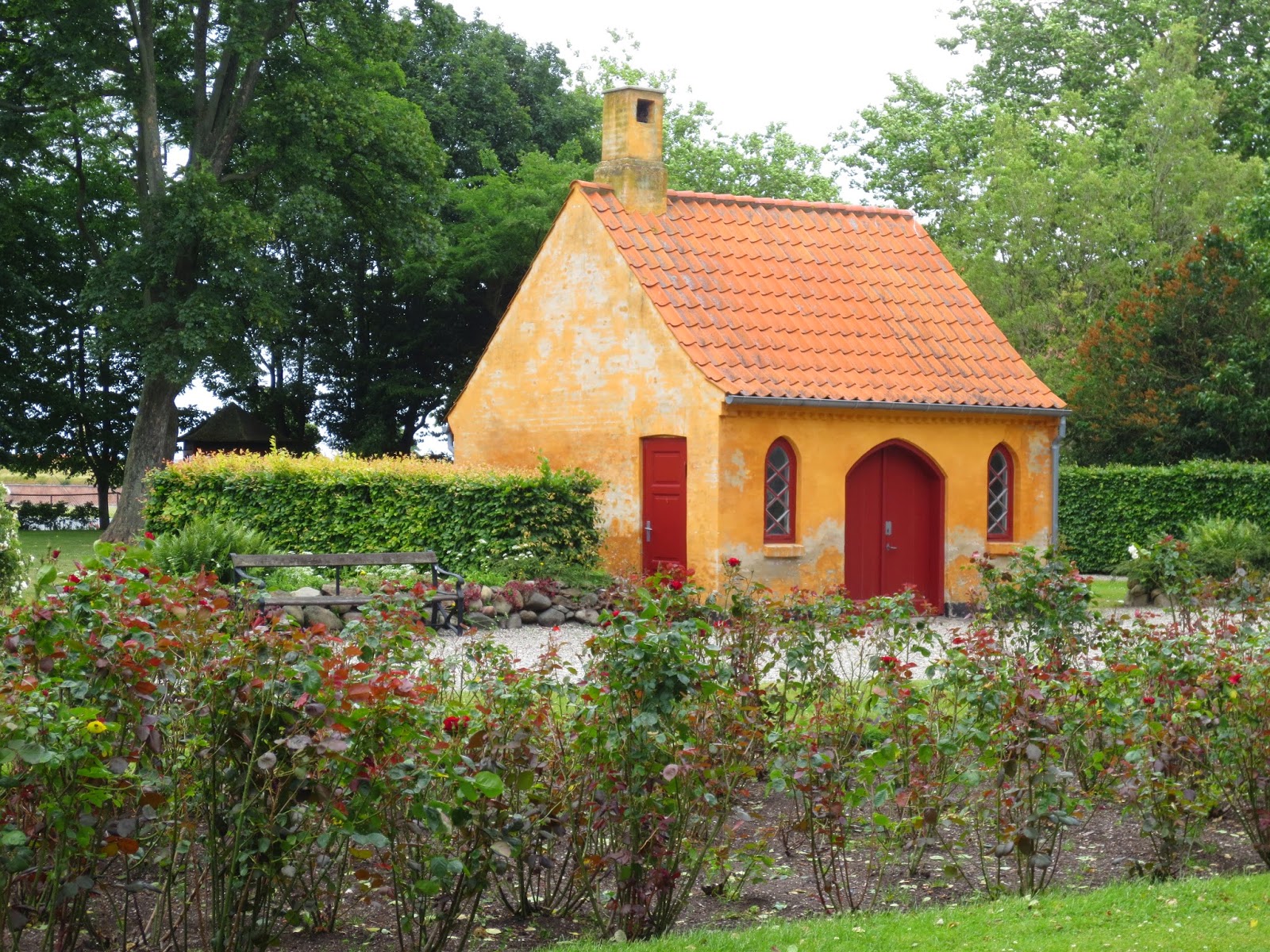
And this charming little building was out back.

 
Beyond the cottage is another stretch of grass, and then there's the sea.  You can hear the call of seagulls from all over town and smell the salty tang of the water.
 
This morning, I attended church at St. Olaf, which is absolutely gorgeous inside, but which I cannot share because photos are not allowed even when there isn't a service going on. Even though I don't speak Danish, I still enjoyed all the hymns (though the congregation seems to be made up of about 25 senior citizens, there is still an organ and full choir singing) and recognized from a few key words when they were reciting the Apostle's Creed.  I also got to see the baptism of two babies.  Church is church wherever you go, which I find both beautiful and reassuring.  
 
After that, I spent a good four hours exploring the famous Kronborg Castle, including a relaxed lunch at the cafĂ© with another London couple and an American woman from New York.  I saw them recognize each other from the train, and when the American asked if she could join them, I sort of jumped in as a kind of double-crasher to the party, and it turned out to be great fun. 
 
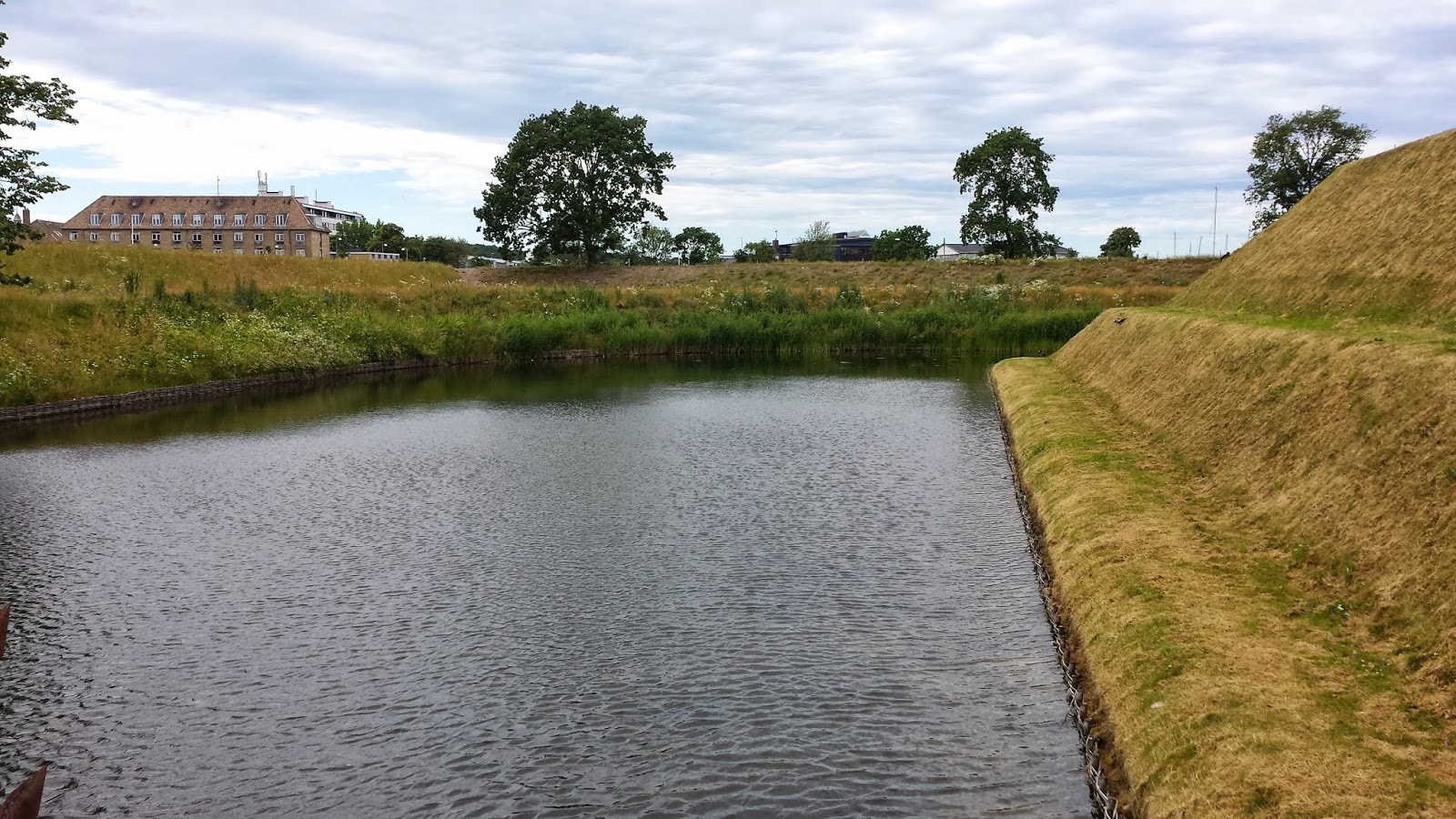
Anyway, back to the castle/fortress, which in the medieval period was a simple square structure (called "Krogen") that was mostly just walls and a couple smallish dwelling places.  Then Frederik II came along and built most of what is now Kronborg, with additions and embellishments added in later years by (you guessed it) Christian IV (Frederik's son).  The weather varied today between brilliant sunshine and rain, appropriately changeable and moody, I suppose.  There's not just one but two moats, and crossing over the second one, I happened upon a little family of swans.


It's hard to get a sense of just how massive this structure is without being there in person, but this should give you an idea.  Take note of how many windows there are, which (because of how expensive glass was in those days) was another way for Frederik to flaunt his wealth.


The large majority of construction was funded by something called the "Sound Dues," which was a toll system established by Erik of Pomerania in the 1400s.  What Kronborg (and earlier Krogen) overlooked is this:
 
This strip of water, known as "The Hook," separates Denmark on this side, and Sweden on the other ("I can see Sweden!").  Only for centuries, Sweden was actually part of Denmark, and because he had sovereignty over the land on both sides of this stretch of water--which was the only passage from the Baltic Sea (basically anything coming to or from the Middle East) to the rest of the world--Erik realized he could make a fortune by charging all the ships a fee to go through.  When a ship came by, it was supposed to lower its flag halfway to show it was coming into port to pay the toll.  If it didn't, then a warning cannon was fired off, and the non-compliant ship would then have to pay both the toll and the cost of the cannon ball.
 
 
When a fire destroyed the entire interior of the castle, Christian IV simply doubled the toll to fund the rebuilding.  This system not only made Denmark a lot of money, but the kings and queens who lived here also benefitted from having first dibs on buying whatever luxurious and exotic goods were passing through on the ships.
 
Because of the fire and because of the castle's function as a military barracks for decades in the late 19th and early 20th century, the interior doesn't look very much like it did originally (or even as it did after the fire) and the plain white walls and ceilings (and floors) would have been much more heavily decorated.  The black and white marble floors and the tapestries are some of the few remaining authentic details that are actually from Kronborg.  Many of the other items were brought in from other locations, though they replicate or match the types of art/furnishings of Christian IV's period, so I'm not really going to bother putting up photos of those rooms (trust me, you're not missing anything).  What I will put up are photos of one of the surviving tapestries and photos from the chapel, which was the only part of the castle untouched by the fire.  The elaborate panels, colors, and detailing is what we were told the rest of the castle would have had as well.  Interestingly enough, this chapel was the first constructed specifically as a Reformed chapel and not a Catholic one.


(this shot came out a bit blurry because of the low light--this is the ceiling paneling)


Again, very dark and heavy (like Rosenborg Castle's interior) but beautiful.  The real "wow factor" (Frederik might not have had the term, but he understood the concept) is this ballroom, which was the largest one in Europe at the time.  Frederik wanted to impress everyone visiting with Denmark's wealth and power, and this must have done the trick because it was famous all over Europe.  No one knows for sure if Shakespeare actually ever visited this castle himself, but it is possible since English and Scottish actors ("players") were brought in to perform for royalty, and King James of England (the same one who sponsored Shakespeare's acting troupe) once stayed at Kronborg with his Danish wife for four months.  Either way, Shakespeare would have been familiar with the grandeur of this castle, and since this was a hub of commerce at the time, it seemed a natural fit to be the setting for Hamlet.
 
 
 Above is a shot when it was empty in the afternoon and below is a shot of it filled with some sort of military event that was going on in the morning when I first arrived, which also gives a sense of its massive scale.
 
 
And this is the Queen's Gallery/passage, which Frederik had built for his wife Sophie so she could get to both the chapel and the ballroom without having to cross the cold, wet courtyard (her chambers were separate from Frederik's, as was the custom of the day).
 
 
Our modern sensibilities might be somewhat creeped out by the fact that he was 38 and she was only 14 (and they were cousins) when they first met, but a number of sources seem to indicate that they were genuinely in love and had a great affection for each other, which was something of a rarity in royal marriages of that time.
 
Some random pictures of doors, because I am slightly obsessed with old doors:


Guess who had the door above ordered?  That's right--as always, he left is trademark "C" with the "4" embedded right under the knocker.
 
 
A super cool passageway
 
 
and a parting shot of the castle when the sun was blazing (the streak of light being some freakish--but neat--accident of my camera)
 
 
Now I am off for some dinner and am hoping I can find someplace to eat other than my hotel, which is ridiculously overpriced.  There are hardly any people here in town now--it's really more of a ghost town--as most of the tourists get back onto buses or the train to go elsewhere after a few hours here, and no one's coming over from Sweden to drink and party on a Sunday evening.  It's borderline eerie how quiet it is here, but it's also kind of a nice change.  Tomorrow I'm back on the train and headed south to Odense.