Tuesday, July 8, 2014

And Then I Drove Some More

Yesterday I bid farewell to Perth and started the journey north.  I say "journey" because far from being a simple trip from Point A to Point B, this experience encompassed not only the more literal definition of traveling, but also the more metaphorical definition of undergoing some sort of challenge and resulting transformation.

My first stop, once I'd circled the city of Perth a time or two trying to get to the right highway (it's a small city, fortunately), was Birnam to see the famous Birnam Oak, which is the last of the great trees from the medieval forest that used to be there.  There is a newer forest now, "newer" in the sense that the trees about one or two hundred years old are "newer."  Given my earlier difficulty with finding the right tree, I was relieved to find some clear signage this time around.

 
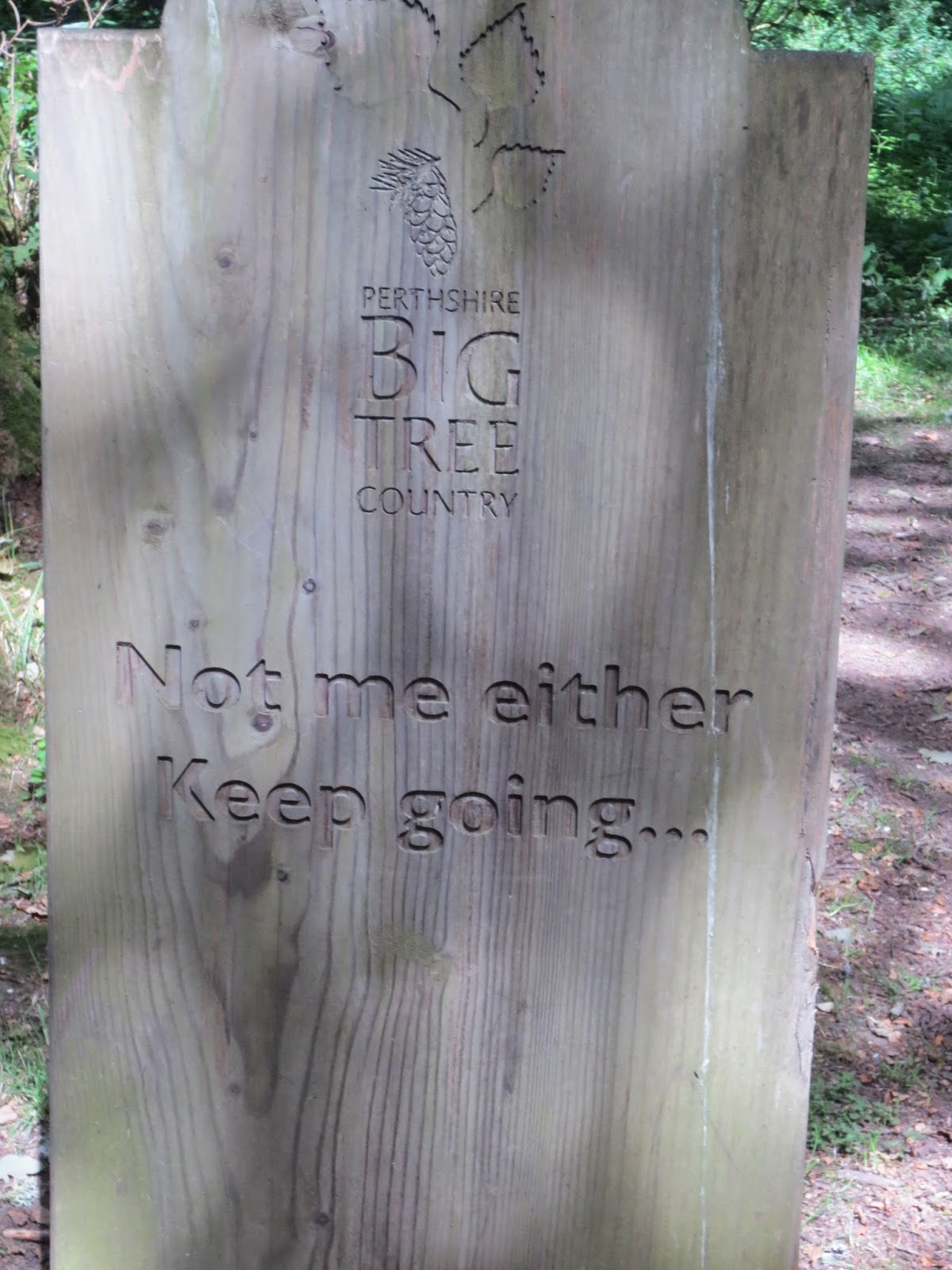
The signs are not only informative--they're also funny.  When I saw the tree above, I got all excited and started snapping a bunch of photos.  And then I read the marker in front of it:

At the next big, old-looking tree, I had learned enough to read the sign before taking photos, and this one gave me a chuckle as well:
And then there it was--the great Birnam Oak, which has grown so large and heavy it's had to be propped up with posts.


Once upon a time, this was a younger, shorter tree, and if it had been in the play Macbeth, Malcolm would have ordered his men to hew down its branches to hold in front of them to disguise their numbers, hence looking to Macbeth like the forest marching upon him.  What confuses me, though, is why Shakespeare would have chosen Birnam Wood when it's nowhere near Dunsinane Hill.  In fact, there are several woods much closer.  Perhaps the photocopied research I received will explain.  If not, I might have to look into that a bit.  Either there's some significance to Shakespeare's choices or he was bad at geography (or just didn't care about minor details like that).
 
Trees and distances aside, I enjoyed a walk along this lovely section of the Tay River, which runs through much of central Scotland. 


Just a couple miles from Birnam is Dunkeld, my next stop.  The cathedral here used to be a Christian mecca in the medieval period (building started on it in the 1200s), housing the relics and bones of  St. Columba.  Part of the cathedral was restored in the 1800s and currently functions as the parish church, but the older section remains in ruins that are currently closed to the public and undergoing some structural repair. 


Below is the one section of the old church still open--the bell tower.

The weather was, as I was told by a shopkeeper, typical Scottish weather--sunny one minute, then cloudy grey and raining the next.  Sometimes it was sunny and raining at the same time.  The same shopkeeper recommended that I make a stop for lunch at a place called Bruar Town, which was basically a shopping center selling all kind of local foods and lots and lots of Harris Tweed.  I stocked up on a few gift items, ate a ridiculously overpriced salad, then got back on the road. 

By now the terrain had changed quite a bit.  Instead of wide, green fields interspersed with gently rolling hills, these highland hills were much higher, craggier, much more densely covered with trees, and more dramatic as a whole.  At home, I tend to be something of a lead foot when I drive.  This is because my life at home is usually quite busy and I'm focused on getting to wherever I'm going as quickly and efficiently as possible.  This is also because there is nothing worth looking at on any of the drives--in fact, it's often quite ugly, making me even more eager to get where I'm going.  But here, you see this:


I was driving on a 2-lane highway, which turned into a road with no clear sides, and until I got a little more used to it, my heart was in my throat every time a truck or bus would come careening around a bend, forcing me to hug the edge of the road and passing by with only a hair's breadth between us.  But there were long stretches where there wouldn't be any other cars at all, and it was easy to imagine myself the only person for miles.  In some ways, this was very disconcerting (especially as my phone, and therefore my GPS, had no reception), but it was also very peaceful.  I could toodle along as slowly as I wanted, drinking in all this beauty and pulling over to take photos whenever I was moved to.  Surprisingly, I felt no anxiety about getting lost even though there were a number of times I had no idea what road I was on or if I was heading in the right direction.  There really aren't that many roads in this part of Scotland, so I just trusted that if I kept driving, I'd eventually come to either a sign or a person who could point me in the right direction.
   
Stopping to ask for directions was actually part of the fun as I met some very nice people along the way, one of whom assured me I could always turn around and come back for the night if I didn't get where I needed to be.
 
Fortunately for me and my bladder, I did eventually arrive where I needed to be, which was here: 
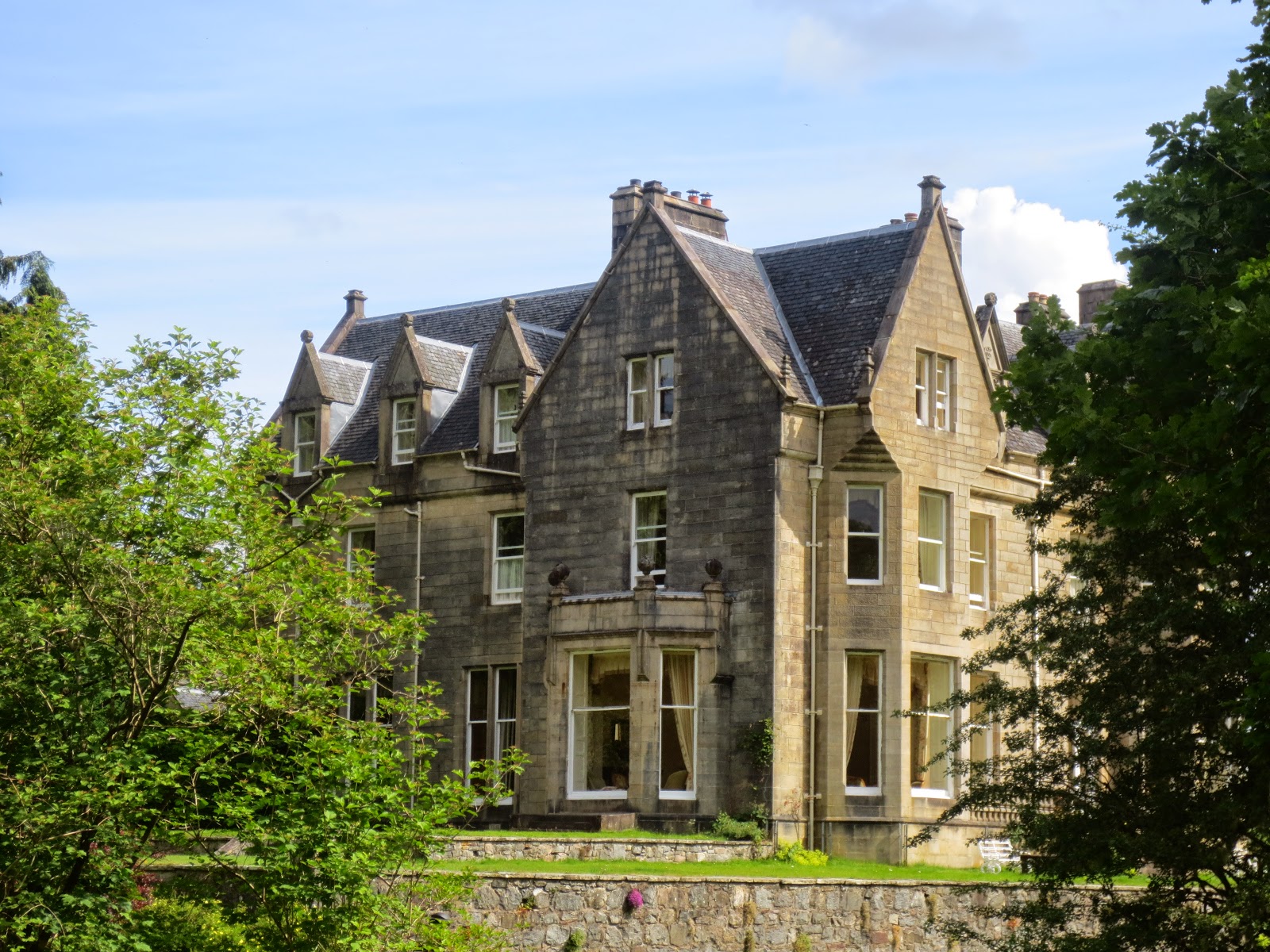
 
This is the Glengarry Castle Hotel, my "splurge" of the trip (thanks in part to a very sweet and generous gift from my neighbors/second-parents, Jerry & Lynda).  It's a manor house that got turned into a hotel, and while it's not quite Downton Abbey, it does feel a bit like I'm staying at my genteel granny's house.  Below is my room and the views out the two windows.


I love the view of the water (Loch Oich), but I think I might love those sheep just a tiny bit more.  I can hear them "baaa," and they are so fat and puffy and sweet that I've had to fight the urge to run downstairs, climb over the fence, and just go hug one.  They're probably quite dirty and smelly up close, but all that puffy wool makes me want to get hands-on, kind of the way seeing a mound of dough just makes me want to squish it.

Okay, back to the manor house, which has these two lovely and comfy rooms downstairs where guests can hang out.

 
I'm currently in an armchair in the latter one typing this up and looking up now and then to gaze at the lake below.  The grounds surrounding this hotel are really beautiful, and I took some time this morning to explore them, following this path along the lake:
 

If you can zoom in on the photo below, you'll see a big bumble bee on the left.  He was going in and out of each blossom, humming with gluttonous contentment.

The hotel itself isn't a castle but is named such because of these ruins of Invergarry Castle (once visited by Bonnie Prince Charlie) which stand further along the property.


One of the things that struck me as I was walking around was how quiet it was.  It was just me and the lake and the trees and wildflowers.  Oh, and the insects, which could be quite noisy in comparison.  It reminded me of how seldom I am in a place of such quiet and stillness, nowhere in particular to go, nothing needing to be done, but just being and surrounded by beauty.  I could almost feel my soul taking a huge, deep breath.
 
I've shifted gears here, and while the entrance hall to the hotel sports a whole table of brochures and almost everyone else staying here jumps in their cars after breakfast and disappears for the day, I'm enjoying a kind of lackadaisical meandering from one moment to the next.  After my exploratory walk, I lay on my bed listening to the sheep and dozing for a bit, read a novel for a while, and then with (a late) lunch time rolling around, decided to drive up a few miles to the town Fort Augustus.  After driving through a bunch of villages yesterday that were comprised of four cottages and a B&B, Fort Augustus seemed like a lively hub.  There were actually a few streets that had restaurants, shops, etc. and near the parking lot, I saw a sign for a rare animal shelter.  Hopeful that there might be some sheep I could squish, I mean pet, I paid the 2 pound entry and jaunted down the path.  These little pygmy goats and a miniature Shetland further on let me pet them, but the few sheep I saw stayed well away from the fence.
 

At the center of town is one end of the famous Loch Ness.  I briefly considered doing a boat tour, but I think I'll wait and see if a sunnier day presents itself and go then.  Meanwhile here's a somewhat gloomy Loch Ness shot:

The big excitement in town occurred just after lunch.  Fort Augustus has a canal allowing boats passage to and from Inverness through a series of locks.  I gathered along with a large crowd to watch this boat slowly lift on the gradually rising water before the gates opened and it moved on to the next lock to repeat the process.  It was the most exciting boring thing I've ever witnessed.

(the boat entering the first lock--the crowds gathered soon after)
 

Sunday, July 6, 2014

I Could Have Danced All Night

It's amazing to me just how much can happen in such a short period of time.  There are days on this trip where I feel like I've lived three or four days (or a full week, even) in just one day.  Yesterday was one of those days.  I started with a visit to Scone Palace, which is just up the road from Perth, and another Macbeth location.  For the last four hundred years, it's belonged to the Earls of Mansfield, and while a portion of the house and the grounds are open to the public, the current Earl will be moving back soon with his family of four children.  In California, many people find it surprising that I currently live in the house in which I grew up (which I bought from my father after my mother died), so it's hard to really comprehend that the same family has lived on the same property for centuries. 


One of the current exhibits focuses on Dido Elizabeth Bell, who spent a good deal of her life here under the guardianship of her great uncle, William Murray, who was the first Earl of Mansfield and the Lord Chief Justice of England and may have been influenced in an important ruling on slavery at the time due to their relationship.  Their story was dramatized in this film:
 
Belle poster.jpg
 
As interesting as that was, my real interest in Scone is that for centuries before it became the seat of the Earls of Mansfield, it was the site of an abbey and the place where Scottish kings came to be crowned.  That ceremony would take place on the hill in the photo below, with the king-to-be seated on the famous Stone of Destiny, whose story I'll recount in a bit. 


As the sign explains, Scottish kings were supposed to be crowned in the presence of all the lords on their own land, but since traveling to each lord on his land individually would have been time-consuming and dangerous, all the lords would instead gather here in central Scotland and bring some dirt from their locale in their boots, pour it out, and stand on it for the ceremony.  Quite practical, really.
 
And as the slab above shows you, Macbeth was crowned here in 1040, which Shakespeare references in the play in a conversation between Ross, an Old Man (really, that's the character's name) and Macduff when they're discussing the recent events of Duncan's murder and how Macbeth has now "gone to Scone."  Of course, Shakespeare's version of Macbeth, while much more exciting and a brilliant study on the nature of ambition and evil and their effects on an essentially noble man, is not very historical.  In reality, Macbeth had a very legitimate claim to the throne that was thwarted by the naming of Duncan as king, and far from being the epitome of gracious, nurturing kingship that he is in the play, the real Duncan was kind of a sad sack and not a very good king.  So real Macbeth (or I suppose I should say historical Macbeth) rightly fought and defeated Duncan for the throne. 
 
Photos weren't allowed in the museum, but I went rogue and snuck a couple with my phone anyway:


That last one contains a replica of the Stone of Destiny, also known as the Stone of Scone or Coronation Stone, right under the seat.  So, about that stone.  There are a number of legends/stories attached to it, all of which are kind of fabulous.  As for its origins, perhaps the most interesting of the legends is that the stone is Jacob's Pillow (Jacob of the Old Testament who dreams of the ladder to heaven), brought to this land by an Egyptian Pharaoh's daughter named "Scota" (which is awfully similar to "Scotland," no?) and eventually moved to Scone by King Kenneth I.  OR maybe it was brought by Gaels from Ireland.  What we do know for sure is that it served as the coronation seat of Scottish kings for centuries.
 
Then Edward I came along and took it as one of the spoils of war, brought it back to London, built a coronation seat like the one in the photo above, and it stayed in Westminster Abbey for the next 700 years before being returned in the 1990s to Scotland.  It now resides on display in Edinburgh Castle.  Or does it?  Some legends say that the monks at the abbey hid the real stone when they knew Edward was coming and gave him a fake.  The fact that early descriptions of the stone don't match the current stone lend some credibility to that, although it's also entirely possible that some of its distinguishing features have worn away in 700 years.  In other crazy news, some university students from Edinburgh stole the stone from Westminster in the 1950s, BROKE it (can you imagine their horror?), found a stonemason to fix it, and eventually returned it after a period of general hullaballoo around the UK.  Apparently, forensic tests were done to confirm it was the same stone, although another story has the students swapping it out with a stone from behind a toilet in a pub.
 
And now back to Scone Palace, which is situated on some really gorgeous land:


One of the resident peacocks strutting around:
 
A highland cow (I can't even begin to express how much I love that they sport boy-band bangs)
 
And some more cows on the way out--mostly mamas and their wee bairns.


I then set out for St. Andrews and enjoyed driving through some of the most beautiful countryside I've ever seen in my life.  This is not hyperbole--this is fact.  I mean, look at this:


Don't be alarmed by the one taken of the road ahead through my windshield.  Yes, I was driving, but I made sure no other cars were around and I was only going about 10 miles an hour.  The trip should have taken about 40 minutes but instead took an hour seeing as I had to take time to stop and gasp.  And pet the horses (or at least pet the one on the right, who was much friendlier than the one on the left):
 
 
My host in St. Andrews, Alix Nunan, welcomed me with tea and some oatcakes topped with scrumptiously delicious local honey and cheese she'd bought at the farmer's market that morning.  Alix is another Wellesley grad (class of '09) whom I met when I went out to Wellesley this past spring to interview for the fellowship (she was fellow finalist).  Having attended St. Andrews for her master's degree, she's been living here for the past few years and graciously invited me to come visit her.
 
After tea, we walked into town via this pretty forest path:


And she showed me some of the university:


Then we walked down to my favorite part, which was the ruins overlooking the North Sea.  I may have had to pinch myself a few times to believe it was all real and I was actually there:


Alix then whipped me up a delicious frittata and salad for dinner, finishing with a homemade berry cobbler and fresh cream--again, most of the ingredients having come from the market that morning.  We bonded over our shared love of Veronica Mars (she has the sticker on her laptop), Anne of Green Gables, and about five hundred other things.  As Anne would say, she is a kindred spirit.  She is also intelligent, talented, funny, and deeply courageous in writing about some very difficult personal experiences, all qualities you can see more of on her blog:  http://theimportanceofbeing.alixwest.com/
 
And now for the dancing.  Those of you reading this blog who know me well know that I tend to keep old lady hours, going to bed at ten-ish and getting up around seven (during the school year it's 6:00).  But this far north, when it looks like this at about 10:30 pm
 
 
you tend to stay up later.  We headed out for drinks a bit after 10:00, met up with Alix's friend Kirsty (a native Scot) and about 11:00, we headed to a restaurant that hosts ceilidhs every weekend.  This involves a live band (in this case, a bagpiper, guitar player, and flautist) and a kind of celtic square dancing.  The band leader walks you through the main steps, and then the music starts and you just go for it.  Ceilidhs are a very old Scottish (and Irish) tradition, and are typically held at events like weddings, highland games, university balls, etc.
 
I can't remember the last time I danced, and let's just say that physical coordination is not my forte, so I had a few butterflies in my stomach when we walked up to the dance floor.  And yes, I ran into people a few times, and yes, I had my feet trod on (and trod on others') more than a few times, but it was so much FUN!  Alix and Kirsty knew what they were doing, but a large majority of the rest of us, including most of my partners through the night (which mostly came from a stag party), didn't have a clue, so we were all bumbling our way through things together and cheering each other when we finally got it somewhat right.  And can I just say that skipping and whirling about is an extremely good workout?  So is laughing constantly.  It was fairly dark in there, but here are a few shots of the one dance I sat out:


The time flew by, and when the band announced the last song, I almost wailed, "Nooooooo!" Glancing at my watch, I saw that it was 1:00am, but I could have easily gone for another hour.  Instead, we went home, I took a shower, and I conked out and had the best sleep I've had since I left home.
 
A somewhat dark and blurry but happy snap of Alix, Kirsty, and me just prior to hitting the floor: