Friday, June 27, 2014

Pretty Paris

 
Birthday #41 got off to a great start when I saw my glamorous nieces Gigi and Emmie waiting for me at the metro stop (I'd just seen them the night before, but I'm with them so seldom that every time feels special):
 
This meeting was made even better by the fact that Gigi had brought me a fresh pain au chocolat.  
 

A short while later, my brother Ben, fresh off the plane from the U.S. joined us, and we set out taking in some of the sights and starting our search for someplace to eat lunch.


We ended up at one of Gigi's favorite spots by the Centre Pompidou and ate in one of the cafes lining the square.


After lunch, we walked along the Seine (which this pretty building overlooks)

 
And stopped at one of my favorite places--Sainte Chapelle, which none of the others had ever been to.  Even though I knew what to expect, it still made me gasp when I walked in.  
   

Floor:


Ceiling:
 
The windows depict over 1,000 scenes from the Bible, so this beauty was not only created to glorify God but also teach and remind the illiterate attendees of the 1200s (and later) of the major figures and stories from scripture.


Everywhere you turn, there is something beautiful, like this clock on the side of the Justice Center on our way out.


We passed by Notre Dame (and the hordes of people waiting in line to enter)

 
and made our way to this famous bookstore on the Seine.


And look what I found...

The perfect birthday present pour moi!
 
 
Even the bag was perfect as it's a quote from Gwendolyn in The Importance of Being Earnest, which is another play I teach.

 
 Next stop was a café on the Ile St. Louis that serves Berthillon's ice-cream.  Photos and even video can't capture how amazing this ice-cream is (especially a scoop of chocolat noir with a scoop of wild strawberry sorbet and a glazed almond cookie wafer), although I think the video Gigi shot manages to convey at least a little of my bliss.


The capper was this guy just outside the café:
 
 
All in all, a pretty fantastic birthday, especially since I got to share it with family even though I am so far from home.  Sadly, Gigi and Emmie boarded the train early this morning to return to their friends in Germany, but Ben stopped by after he dropped them off and we had a nice, relaxed (we sat around for an hour and a half) late breakfast together.  Apparently, I don't know where to look when I take photos with my own phone.


Fueled by my omelet and greens, I bid goodbye to my brother (who is here for business and in meetings for the next few days) and set out for Musée national du Moyen Age, formerly known as the  Musée de Cluny.  "Moyen Age" means the Middle Ages, so perfect for this medieval/Renaissance history lover.


So many of the various churches and other sites in the city have been damaged/destroyed and rebuilt multiple times over the centuries, so this location houses and preserves a lot of medieval pieces that were either saved or discovered through the years and part of some earlier incarnation of said locations.  Inside was an impressive display of stained glass windows (some from the original Sainte Chapelle and other Paris churches):


It's amazing to me that people who didn't even have flush toilets knew how to create such gorgeous art that is as vivid today as it most likely was a few weeks after it was produced.

There were also lots of tapestries like this:

And of course the highlight is the famous Lady and the Unicorn tapestries, representing the five senses and a mysterious (different interpretations abound, but no one knows for sure) sixth sense, although sadly I've just realized my photo of it didn't turn out well.  There was a gaggle of French school children sitting on the floor that I was trying to work around, so I blame it on them.


Down these stairs and to the right is a doorway and a room full of statuary salvaged from Notre Dame.
 
The little explanation card explains that these statues were "damaged" during the Revolution, but I overheard an elderly British gentleman tell his wife that the mob chopped the heads off the statues, which happened to be kings.


Other medieval church stuff:


And this gorgeous little chapel commissioned by the man who first started collecting these items:
 
Back outside: 
 
I refueled and relaxed with some people watching at our café from yesterday, which has a nice view (in the distance) of Notre Dame.  Oh, and I may have also ordered some more ice cream after this salad.
 
 
I was enjoying myself so much that I kind of lost track of time, and realized I'd better hustle if I was going to make my final stop of the day before closing--Père Lachaise Cemetery.  I made the mistake of getting off the metro at the Père Lachaise stop (silly me) instead of going all the way to the Philippe Auguste stop, which is the one that actually puts you at the entrance.  So I'm walking along in a hurry trying to find the entrance and accidentally walked over a metro ventilation grille just as a strong gust of wind hit me, and my skirt flew up.  I don't know if all the tourists walking behind me have seen London, but they've definitely seen France and my underpants. 
 
With the sky filling with clouds, the wind blowing, and the crows cawing, there was definitely a haunting beauty to my surroundings.


Since closing time was rapidly approaching and I couldn't possibly get to all the graves I wanted to (this place is massive), I decided to take the quote on my bag as a sign and make a beeline for Oscar Wilde's tomb.  Which of course was on the opposite side of the cemetery.  I arrived huffing and puffing and with a new blister on my foot, but I had a full five minutes to spare.  I can't say I love the style of this tombstone, but I do love that in spite of the signs asking people to please not mark the stone, the tradition of leaving lipstick kisses continues, albeit above the glass.  


As I was leaving, I caught sight of this elderly woman with a scarf on her head and her hands full with a watering can, jug of water, and shopping bag, clearly heading somewhere to tend a grave, and it reminded me that it is still a working cemetery. It must be annoying to have to pass a bunch of gawping tourists to pay your loved ones tribute.

 If I can manage to get up at a decent hour (which is a wee bit questionable at this point), I hope to visit a flea market in the 4th arrondissement before I have to check out and head for the airport.  Next stop, Edinburgh!
 

Tuesday, June 24, 2014

Bicycle p.s.

While it kind of breaks my heart to have to report this, in the interest of full disclosure, I noticed something this evening as I was passing by some parked bikes--several had a discreet little "U" lock that attaches the frame to either the front or back wheel.  I imagine a lot of the Copenhagen bikes had those as well, but I just didn't notice them or know what to look for.  But the bright side is that A) not every bike here had one, and B) it's only a token lock.  Back in the U.S.  that wouldn't deter anyone--they'd either carry off your whole bike or just detach the parts they could walk away with.  Or get really mean and just slash your tires like someone did to my bike my freshman year of high school.

So I'm still going to cling to my belief/fairy tale that in Denmark, you don't have to worry about getting your bike stolen because everyone is so nice and respectful.

The End.

Fairy Tale City

No matter where you are in Denmark, you're not far from the sea.  I was reminded of this on the train ride from Helsingor to Odense (by way of Klampenborg and Kobenhavn--"havn" meaning "harbor") where I got glimpses like this:


This was just one of a row of turbines, but I was too slow on the draw to get them all before the train whizzed away.  There was also field after field of lovely green and golden waves of crops, punctuated by the occasional row of bright red flowers (couldn't tell if they were poppies or tulips).  While Helsingor was charming in many ways, the people there weren't very friendly--they seemed a bit jaded, which, given the amount of tourists flooding in every day, is somewhat understandable.  All the same, it was refreshing (and mood-lifting) to arrive in Odense and find the same level of cheerful openness that I encountered in Copenhagen.  The cab driver who picked me up at the train station seemed rather grim at first, but after I asked a question or two, he livened up, and by the end of our seven minute drive together, he showed me several photos of his grandson on his phone before we got out of the car. 

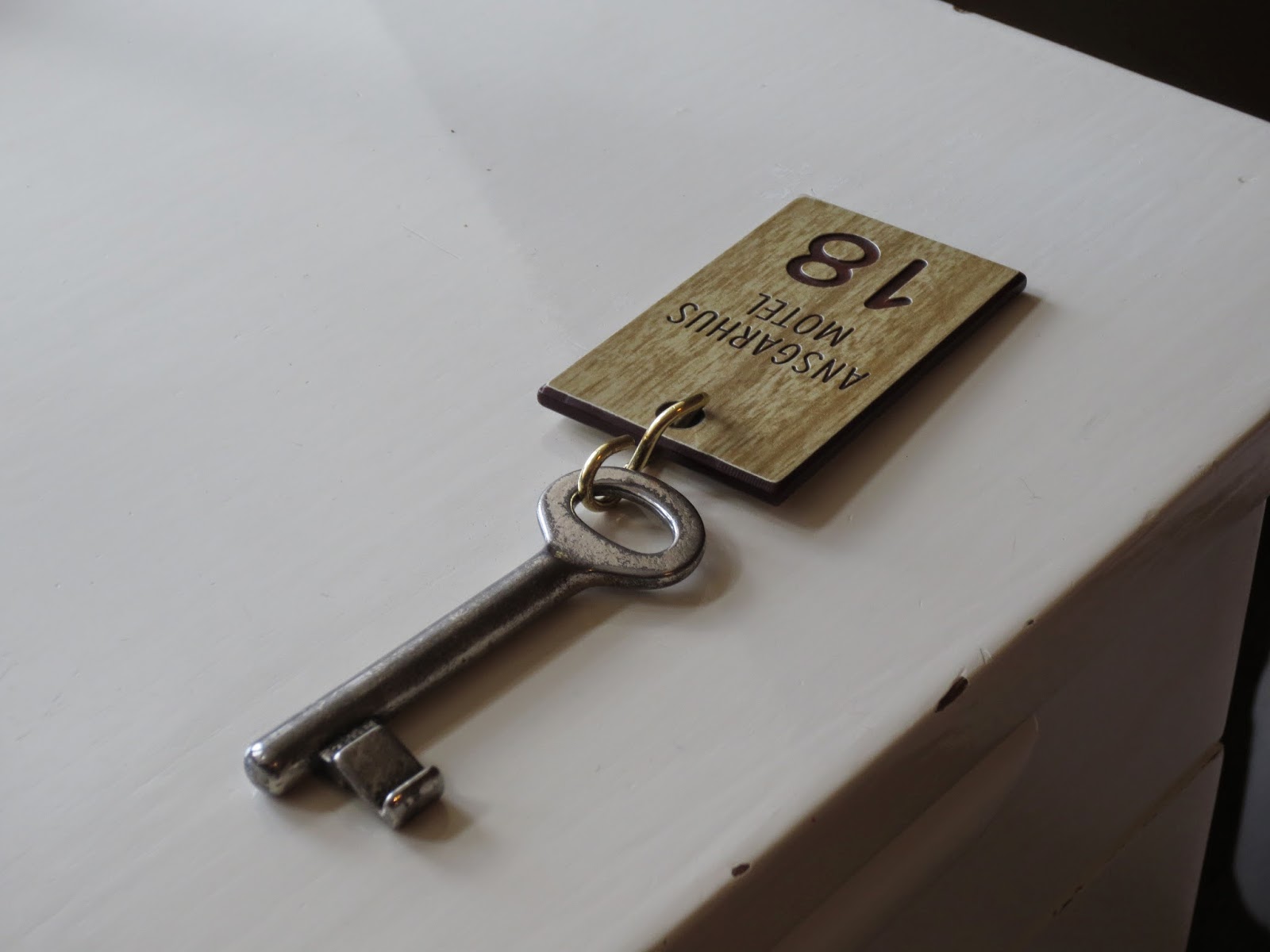
My room here at the Ansgarhus Motel is very small and simple, but I find it cozy, charming, and the perfect size for being on my own.  It reminds me a bit of my dorm days, which were happy times for me.  I just have to watch my head a little with the sloping walls.


How can you not be charmed by a room with a key like this:


Or a window like this:


Not to mention the artwork (someone really should have told this lady that her breasts were hanging out of her dress):


Though everything was closed by the time I arrived by train, checked in, and ate some lunch (all the museums, etc. shut down here around 4:00), I still enjoyed walking around.  Odense is the birthplace of Hans Christian Andersen, whose collected works I've been reading over the last few days, and it's easy to see where he got the inspiration for his fairy tales.


These houses (near the H.C.A. museum and house) are all very typical of the houses from his childhood.  Sadly, my taxi driver said a huge number of them were destroyed when they built the main road through the city fifty years ago, but at least these remain.


On my walk back to my hotel, I discovered this lovely park with a statue of Hans Christian himself at its center:


I sat down on a bench facing this (above), and seconds later, a bird flew over to the fountain to take a drink.


And here's one of me enjoying the moment.  


I suppose I'll have to get better at having other people take pictures of me in various historic sites, but I generally hate posing for photos by myself and always come out looking as stiff/awkward as I feel.

Today I headed back to the Hans Christian Andersen museum, which is built around the rooms where he was most likely born (his parents didn't have a place of their own, so it's assumed they stayed with relatives who lived here for his birth).  Having read several of his stories in the last several days, I can understand where some of the darker elements come from given a more complete picture of his life.  The mortality rate of infants and children was about 40% at the time he was born, he lived in extreme poverty for his entire childhood and a good portion of his young adult life, and even though he fell in love several times, none of the women returned his feelings and he remained unmarried and childless his entire life, though he longed for a family of his own.  He also lost his father, whom he loved very much, at a young age, and his mother ended up being an alcoholic.  He left home to try and break into the theater scene in Copenhagen when he was just 14 years old.

Below is the home where he lived with his father (and then mother after his father died) from age 2 to 14.  This was not theirs alone, however--two other families also lived in the same dwelling, and each family had only one room to themselves.


This was the Andersen room


And this was the kitchen (no running water--they had to fetch that from the river) shared by all three families.  It's hard to tell from the photo, but there's about enough room for two (maybe 3 if you don't need to mover your arms) in there.


When the woman at the front desk told me that one of the families in the other rooms had five children, I asked how they all possibly fit in one room, and she said that not all five would be home at the same time since it was common practice for poor families to ship their children off at age 8 or 9 to go work on a farm or in a wealthier person's house.

One of the things Hans Christian had an unusual talent for (besides writing) was creating beautiful and delicately wrought paper cuttings, which he would often craft for the children of families he was friends with.  In fact, during his poorer adult years, he would rotate from friend to friend for dinners and then thank them by making these little gifts for the family. 


He would also often paste them into blank journals and add poems and stories.


There were a number of quotes from his various stories, diaries, and autobiography, and below are just a small sampling of some that moved me most.


And for any of you who are writers/artists and face criticism from others, look what one critic wrote about Andersen (and this was one of many negative comments he received from both reviewers as well as personal friends):


Good thing he ignored this guy.  It helped that he had a number of supporters over the years who believed in him and encouraged him.  Something else I was interested to read about him is that he won a travel scholarship when he was a young man, and continued to travel extensively (and for long periods of time) for the rest of his life.  One of his bestselling books (besides his fairy tales, of course) was the one he wrote about his travel experiences.  Perhaps in that regard, it was good that they didn't have blogs in those days since he needed the money.

And before we leave Hans behind, here's a "mental photograph" he wrote of himself (this is the translation of the original document, which didn't photograph very well):


My next stop was the Odense City Museum, which had a great little display on the medieval period in the city.  I took a ton of photos of all the explanations for my own research purposes and the exhibit gave me a great feel for local life in that era, but there wasn't a whole lot that would translate well to this blog.  But if you ever visit Odense and are interested in history, it's worth a stop.  It's also housed in a really cool Renaissance era building that I completely spaced on and forgot to photograph (all this reading and looking and taking in of information is overloading my brain a bit).

Next stop was the Odense Cathedral, also called St. Knuds Kirke ("kirke" meaning "church").  There was a medieval church on the site originally, where King Knute was murdered by some rebels, and after he was canonized, a newer, fancier cathedral was built and his bones (along with his brother's) were put in the crypt.  A third and even more elaborate church was built during the Renaissance, and it was renovated in the 1800s and now looks like this:


What's kind of extra cool is that King Knute's and his brother's skeletons are on display in the crypt.  I tried to photograph them too, but it was too dim to get a decent shot.  Anyway, just picture some old, brownish skeletons.

Tomorrow I take the train back up to Copenhagen Airport to fly to Paris.  I'm excited to meet up with my nieces and brother there to celebrate my birthday (and thus may take another short break from this blog--we'll see how things go), but I'm sad to be leaving Denmark.  Despite how expensive everything has been, I've really enjoyed my time here and hope to return again before too long.  Especially since I've already picked up a tiny bit of the language and can say "hi" and "thank you" and "bye" like a native.  It helps that their greeting and casual farewell is, respectively, "hej" (pronounced "hi") and "hej hej!" ("hi hi!").  Thank you is simply "tak."  A lot of the language doesn't resemble English in the least, but there's a fair amount that does, and it's easy to see how certain words that the Vikings brought over to England morphed over the years.  One of the things that made this visit easy, though, is that pretty much everyone speaks excellent English, which they learn in grammar school.  There have been a couple times, though, were I've seen translations in the museums and churches that have made me laugh a little.  I can't remember a specific example but one the I loved here at my motel is the manager, Kenneth, calling my purse a "lady bag."  Since my own ability to speak with anything resembling coherence and fluency in any other language is pretty much non-existent, though, I must say I have nothing but admiration for the Danish--especially since I've heard many of them break into a third language with equal fluency.

While it's probably a great inconvenience in many ways, another thing I'm going to miss about this country is how much ancient history is literally right under their feet. The main pedestrian street where most of the shops are used to be the main road the Viking kings would use to get around Odense.  In their digging to expand their roads and metro system, they came across these medieval ruins and are now having to pause and excavate:


I am also going to miss all the friendly, helpful people and the amazing seafood and sushi available everywhere you go.  Well, tak, Denmark, and until I visit again--hej hej!